Honghe Machinery Honghe Machinery

How to Enhance Dust and Noise Control in Glass Workshops?

Time:2026-10-19 Author:Isabella
0%

Glass workshops combine precision, heat, abrasive materials, and constant movement. These conditions can release fine glass dust and create noise from cutting tables, grinders, compressors, and extraction systems. Without practical controls, workers may experience irritated eyes, breathing discomfort, communication difficulties, or hearing fatigue. The goal is not simply a cleaner floor. It is a safer, more controlled production environment.

This guide explains how to Enhance Dust and Noise Control in Glass Workshops through engineering, maintenance, work practices, and personal protection. Local exhaust ventilation should capture dust close to its source, rather than allowing particles to spread across the room. Wet cutting can reduce airborne dust, while sealed equipment and suitable filters support more reliable control. Regular cleaning matters. Dry sweeping may disturb settled particles, so safer collection methods should be selected according to the material and equipment.

Noise control requires equal attention. Enclosures, isolation mounts, quieter tools, and planned equipment maintenance can reduce exposure at its origin. Workers should also use properly selected hearing protection and receive clear instruction. Simple changes help.

Experienced supervisors can improve results by checking air movement, filter condition, noise levels, and employee feedback during real production. However, no single solution fits every workshop. A control plan may look effective on paper but fail near an open cutting station or poorly positioned extractor. Continuous review is essential. Some assumptions will be wrong. Honest observation, documented inspections, and timely adjustments make the system more dependable and support healthier glassworking practices.
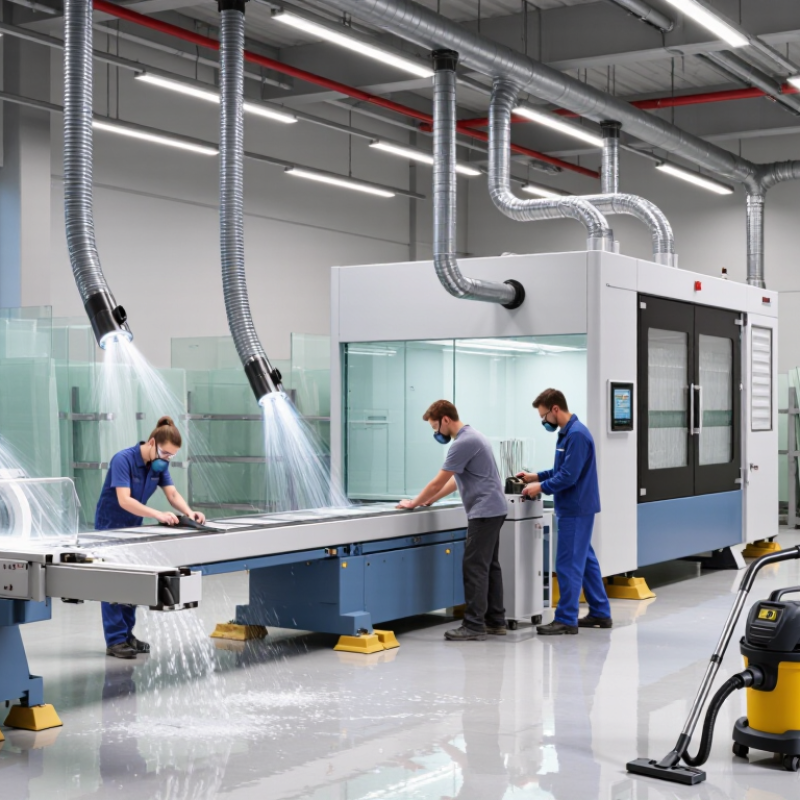
How to Enhance Dust and Noise Control in Glass Workshops?

Understanding Dust and Noise Risks in Glass Workshops

Glass workshops create a twin hazard: airborne dust and intense, uneven noise. Cutting and grinding can release fine crystalline silica particles, especially when dry methods are used. These particles may reach deep into the lungs without obvious warning. Noise comes from saws, drills, compressors, and sudden impacts on glass sheets. At close range, conversations become difficult, and repeated exposure can damage hearing. That risk is often underestimated.

A practical inspection should follow dust from its source to the worker’s breathing zone. Look for residue on benches, ledges, clothing, and nearby tools. Use wet cutting where suitable, and capture dust locally before it spreads. General ventilation helps, but it cannot replace source extraction. Workers need suitable respiratory protection, correct fit, and clean-shaven seal areas when required. Small gaps matter. Where exposure remains uncertain, a qualified occupational hygienist can conduct air sampling and recommend controls.

Noise assessment should include peak events, not only average machine levels. Useful controls include equipment enclosures, regular maintenance, quieter tooling, and greater distance from operating machinery. Hearing protection should match the task and preserve warning signals. Training must cover cleaning methods, filter checks, and responses to failed controls. One weakness in many workshops is relying on protective equipment while ignoring damaged extraction hoses. That habit deserves review. Records of inspections, exposure measurements, health checks, and worker feedback make decisions more reliable.

Identifying Main Sources of Glass Dust and Workshop Noise

Glass dust rarely comes from one operation. Cutting, edging, drilling, and polishing can release fine particles around the tool, while dry sweeping redistributes settled dust. Broken cullet creates larger fragments, but grinding residue may remain airborne longer. Most common glass is amorphous, not crystalline silica. However, some glass-containing materials and coatings may contain crystalline silica. The composition must be checked before exposure decisions are made.

Noise has several overlapping sources. A cutting wheel produces sharp, intermittent peaks. Grinders create continuous high-frequency noise. Compressors, extraction fans, and sheet impacts add background exposure. The National Institute for Occupational Safety and Health recommends an 85 dBA limit over eight hours, using a 3 dB exchange rate. The Occupational Safety and Health Administration uses a 90 dBA permissible exposure limit over eight hours, with a 5 dB exchange rate. These figures are not interchangeable.

A practical assessment should map dust and noise by task, position, and shift duration. Personal sampling is stronger than judging a hazy room by sight. For respirable crystalline silica, the occupational exposure limit is 50 micrograms per cubic metre over eight hours under the United States silica standard. That number is easy to misread. It does not describe every type of glass dust. One weak assumption is treating a quiet corner as a safe corner; reflected sound can remain high beside walls and machinery. Dry sweeping is another common failure. It can visibly clean the floor while increasing airborne particles. Records should include filter condition, tool settings, ventilation performance, and worker location.

Designing Effective Ventilation and Dust Collection Systems

How to Enhance Dust and Noise Control in Glass Workshops?

Designing effective ventilation begins at the dust source. Cutting and grinding glass can release fine particles that remain suspended around workers’ breathing zones. Local extraction hoods should sit close to the cutting table, with airflow directed away from the operator. Capture velocity must be checked during real production, not only during installation. Air must move. General ventilation alone is rarely enough. It may spread dust instead of removing it. Use suitable filtration, inspect duct joints, and prevent contaminated air from returning indoors. Enclosed grinding areas and damp processing methods can further reduce airborne particles.

Tips: Keep extraction ducts short and direct. Clean filters before pressure rises noticeably. Mark noisy equipment zones clearly. Use acoustic panels away from dusty airflow. Fans should provide steady airflow without creating unnecessary noise. A simple airflow indicator can reveal blocked filters early.

Noise control needs equal attention. Choose balanced fans, isolate vibrating machines, and mount equipment on stable supports. Closing a compressor inside a ventilated acoustic enclosure often reduces background noise near workstations. However, sound-absorbing materials can collect dust when poorly positioned. This detail is easy to miss. In practice, even a well-designed system may underperform when doors stay open or operators bypass the hood. Regular checks, worker feedback, and recorded airflow readings make the system more dependable. Improvements should be adjusted after observing actual tasks, not assumed from drawings alone.

How to Enhance Dust and Noise Control in Glass Workshops? — Designing Effective Ventilation and Dust Collection Systems
Control Dimension Design Parameter Recommended Target or Reference Value Application in a Glass Workshop Verification Method
Source Capture Capture velocity at the dust-generating point Approximately 0.5–2.5 m/s, selected according to the operation and degree of dust dispersion Use stronger capture for dry grinding, cutting, polishing, and abrasive finishing than for low-energy handling operations. Measure air velocity at the hood opening with a calibrated anemometer.
Local Exhaust Ventilation Hood placement Position the hood as close as practical to the emission source; enclosure is preferred where feasible Partial enclosures around cutting or grinding stations usually control dust more effectively than ceiling-mounted general exhaust. Check hood distance, visible dust movement, and smoke-tracer airflow during commissioning.
Ductwork Transport velocity for particulate-laden air Typically about 18–22 m/s for heavy or abrasive dust, subject to engineering review Maintain sufficient velocity to reduce dust settling while avoiding unnecessary fan energy, abrasion, and noise. Measure airflow and calculate velocity from duct cross-sectional area; inspect low points for deposits.
Airflow Balance Make-up air Provide replacement air approximately equal to exhausted air, while maintaining directional airflow toward the collection system Uncontrolled make-up air can create drafts, disturb capture zones, or cause doors to slam and fans to lose capacity. Review pressure relationships and measure supply and exhaust airflow after system balancing.
Dust Collector Filter performance Use a collector rated for the particle size and material; HEPA filtration is rated at least 99.97% efficient at 0.3 µm when required Select filters based on glass dust characteristics, moisture, temperature, combustibility, and the required discharge-air quality. Review the filter specification, installation integrity, and differential-pressure trend.
Filter Monitoring Differential pressure across filters Use the manufacturer’s operating range; a rising trend indicates loading, damage, or restricted airflow Install a pressure gauge or electronic sensor and define alarm points before airflow falls below the design value. Record pressure readings routinely and compare them with the commissioning baseline.
Dust Disposal Collection and housekeeping Use sealed containers or enclosed discharge systems; avoid dry sweeping and compressed-air blowdown HEPA-equipped industrial vacuuming or damp cleaning helps prevent settled dust from becoming airborne again. Inspect floors, ledges, machine surfaces, bins, and transfer points during scheduled housekeeping audits.
Silica Exposure Respirable crystalline silica control Where crystalline silica is present, assess exposure against the applicable occupational limit; the OSHA 8-hour PEL is 50 µg/m³ Risk assessment is especially important when processing silica-containing materials, refractories, ceramics, or engineered stone. Use personal or area air monitoring performed by a qualified occupational-hygiene professional.
Noise Control Worker noise exposure Use a hearing-conservation approach at or above 85 dBA as an 8-hour time-weighted average; confirm local legal requirements Grinding wheels, fans, compressed air, duct turbulence, and vibrating panels are common noise sources. Conduct calibrated dosimetry or sound-level measurements at operator locations.
Fan and Duct Noise Noise reduction measures Select fans near their efficient operating range and control outlet velocity, vibration, and regenerated duct noise Use vibration isolators, flexible connectors, acoustic enclosures, silencers, and lined sections where compatible with dust service. Compare sound levels before and after installation at fixed measurement points.
Room Ventilation General dilution ventilation Use general ventilation as supplementary control; do not use air changes alone as a substitute for local exhaust The required air-change rate depends on heat load, room volume, process emissions, occupancy, and the effectiveness of source capture. Confirm room airflow patterns with smoke visualization and verify contaminant levels through exposure monitoring.
System Maintenance Inspection and preventive maintenance Inspect hoods, ducts, filters, fans, seals, and alarms at defined intervals; re-test after modifications A practical schedule includes operator checks each shift, visual inspections weekly or monthly, and formal performance testing at least annually. Keep records of airflow, pressure drop, noise, filter changes, repairs, and corrective actions.

Using Equipment, Barriers, and Personal Protective Measures

How to Enhance Dust and Noise Control in Glass Workshops?

Using Equipment, Barriers, and Personal Protective Measures

Effective control begins with equipment that captures hazards near their source. Wet cutting can reduce airborne glass dust, while local exhaust ventilation removes particles before they spread across the workshop. A qualified safety professional should check airflow regularly, especially around cutting tables and grinding stations. Vacuum systems need suitable filters and careful maintenance. A blocked filter can quietly reduce protection.

Noise control needs equal attention. Enclose loud machinery where practical, and place sound-absorbing panels on nearby walls. Keep noisy equipment away from rest areas and administrative spaces. Measuring noise levels during a normal production shift gives more reliable information than guessing. Short measurements can miss peak exposure.

Barriers should separate cutting zones from walkways. Clear screens can contain fragments while preserving visibility. Workers need properly fitted eye protection, face shields for high-fragment tasks, and hearing protection selected for the measured noise level. Respiratory protection may be necessary when engineering controls cannot maintain clean air. Fit testing, seal checks, and clean storage matter. Disposable masks left on dusty benches do not provide dependable protection.

Use task-appropriate gloves, but never wear loose gloves near rotating parts. That detail is often overlooked. I have seen well-designed controls fail because doors stayed open and workers removed hearing protection for quick conversations. Training should include these real habits, not only written procedures. No setup is perfect. Review dust deposits, worker feedback, and maintenance records each month.

Maintaining and Monitoring Workshop Dust and Noise Controls

How to Enhance Dust and Noise Control in Glass Workshops?

Maintaining control begins with regular measurement, not visual judgment. Supervisors should map cutting, grinding, polishing, and loading areas before testing them. Use personal dust sampling during normal production, including busy shifts and open-door conditions. Respirable crystalline silica requires laboratory analysis; a basic particle meter cannot identify silica.

OSHA’s silica standard sets a 50 microgram-per-cubic-meter, eight-hour exposure limit, with a 25 microgram action level (OSHA, 29 CFR 1910.1053).

Local extraction should be checked at the tool, not only near the ceiling.

Noise monitoring needs equal discipline.

Calibrate sound-level meters and personal dosimeters before and after each survey. NIOSH recommends limiting occupational exposure to 85 dBA over eight hours, using a three-decibel exchange rate (NIOSH, Criteria for a Recommended Standard: Occupational Noise Exposure).

Record readings beside specific machines, shift times, and operator tasks. Short high-noise events matter.

Our early checklist looked complete, but it ignored door-open conditions. That mistake changed the results. Recheck controls after equipment changes, filter loading, or layout adjustments.

Compare monthly records for rising dust or noise patterns. A quiet corner may still hide exposure.

Workers should report damaged extraction arms, unusual vibration, or blocked filters immediately. Supervisors need to document the response, not merely the complaint.

Some controls will fail occasionally. The monitoring system must reveal that failure quickly.

FAQS

What are the main dust risks in a glass workshop?

Cutting and grinding may release fine crystalline silica particles. These particles can travel deep into the lungs. Dry methods increase concern.

Why is general ventilation not enough?

General ventilation may spread dust instead of removing it. Local extraction should capture particles close to the cutting or grinding point.

How can workers check whether dust controls work?

Inspect benches, ledges, clothing, and tools for residue. Check airflow during real production. An airflow indicator can reveal blocked filters early.

What ventilation details need regular attention?

Keep ducts short and direct. Inspect joints and filters regularly. Contaminated air must not return indoors. Small gaps matter.

How can wet processing reduce airborne dust?

Wet cutting can reduce airborne particles during suitable tasks. It should support, not replace, effective extraction and maintenance.

What causes harmful noise in these workshops?

Saws, drills, compressors, and sudden glass impacts can create intense noise. Peak events matter, not just average machine levels.

How can a workshop reduce noise exposure?

Enclose loud machinery where practical. Isolate vibrating equipment and use stable supports. Greater distance also helps. Air must move.

What personal protective equipment may workers need?

Workers may need fitted eye protection, face shields, hearing protection, and respiratory protection. Selection should match the measured task risks.

Why are fit checks and storage important for respirators?

Small seal gaps can reduce protection. Fit testing, seal checks, and clean storage improve reliability. Dusty benches are poor storage areas.

What common control failures deserve review?

Open doors, bypassed extraction hoods, damaged hoses, and removed hearing protection can undermine good designs. No setup is perfect. Worker habits matter.

Conclusion

Enhance Dust and Noise Control in Glass Workshops by first understanding how fine glass particles and high sound levels affect workers, equipment, and product quality. Common sources include cutting, grinding, drilling, polishing, material handling, and poorly maintained machinery. Identifying when and where dust and noise are generated allows workshop managers to develop targeted control strategies rather than relying on general precautions.

Effective control begins with well-planned ventilation and dust collection systems that capture particles close to their source and prevent them from spreading. Equipment should be maintained regularly, while physical barriers, quieter operating methods, and suitable work-area layouts can help reduce noise exposure. Workers should also use appropriate protective equipment, including respiratory and hearing protection, when necessary. Finally, routine inspections, air-quality checks, noise monitoring, cleaning schedules, and employee training are essential for confirming that control measures remain effective and for addressing problems before they become serious.

Isabella

Isabella

Isabella is a dedicated marketing professional with a sharp focus on driving brand growth and engagement through strategic content creation. With an extensive background in digital marketing, she combines her passion for storytelling with her keen understanding of industry trends to deliver......